The Royal Swedish Academy of Sciences has awarded the annual $500,000 Crafoord Prize in Biosciences for 2007 to Robert Trivers, Rutgers University, "for his fundamental analysis of social evolution, conflict and cooperation."
Monday, January 22, 2007
Trivers gets Crafoord Prize in Biosciences
The full story is on edge.org

Monday, January 08, 2007
Smelling in stereo
Even if you don't listen to the entire story (which is informative), you should at least watch the video. Kind of creepy to watch a student crawling around a field! Anyway, the two Berkeley researchers found through two experiments, in which participants tracked "essence of chocolate," that humans detect different information from each nostril to form a 3D map of olfactory cues. Check out the story here.
Friday, November 10, 2006
Good genes new name for sexy sons???
Steve Gangestad was here at UT this week and gave about the same talk he gave last year at FAU. He also gave our seminar a new in-press paper at JPSP to read (about women's mate preference shifts across the menstrual cycle). He presented some of the data from that paper in his talk but basically these results show that women prefer men who are confrontative, arrogant, attractive (etc) when fertile and do not prefer men who are faithful, intelligent, kind (etc). Well...I started thinking about this...if women want these men when they are fertile, they are obviously attempting to produce offspring with these men. And these are traits that researchers have termed markers of "good genes". But they are only good genes for male offspring who can short-term mate. So how are is this theory different from sexy sons? I asked Gangestad what he thought and got a round-about answer. Then I asked him, "Well you certainly wouldn't want these traits in your daughters would you?" (particularly arrogance and confrontative personalities) and he said no. So I said "well then it seems like to me if you don't want these traits in daughters, these women are trying to get good STM genes for their male offspring, which seems like sexy sons to me." And he summed it up by saying more research is needed.
So I guess the point of all this is...what do you guys think? I'm certainly not denying the research that shows that women drastically shift their preferences when they are fertile, but I guess what I want to know is, are they choosing then to have male offspring who will be good at STM? And what then about their female offspring? (Or I guess I'm also asking...am I totally crazy and way off-base here? ha ha)
So I guess the point of all this is...what do you guys think? I'm certainly not denying the research that shows that women drastically shift their preferences when they are fertile, but I guess what I want to know is, are they choosing then to have male offspring who will be good at STM? And what then about their female offspring? (Or I guess I'm also asking...am I totally crazy and way off-base here? ha ha)
Saturday, November 04, 2006
Entertainment for Evolutionists
So back when I had time to waste, as an undergrad, my roommates and I loved to play Sims--to play "god" with other people's lives. And now, apparently, we can all be god (or natural selection ;) in a video game, Spore, where you evolve from a single cell organism all the way to an interplanetary traveler. It sounds a little goofy, but kinda cool, because you have to use your "DNA points" (or reproductive success) to "mutate" and adjust your features to fit a particular environment. Anyway, just thought y'all might find it of interest. You can watch an entertaining little demo here, or catch the interview I caught here (click on "intelligent design"). It'll be a merry christmas for all the little evolutionists out there. ;)
Thursday, November 02, 2006
Dawkins Dawkins everywhere!
So he was on the Colbert Report, he's on myspace, he's been on NPR...and now he's been mocked on South Park! I'm sure the episode will turn up on YouTube or you can probably see clips of it on Comedy Central's webpage. Basically, Ms(r) Garrison refuses to teach evolution to his class because he doesn't believe it (he says we are the retarded offspring of five monkeys having butt sex with retarded fish frogs) and so the principal brings in Richard Dawkins to explain evolution. Of course he promotes his atheism, converts Ms. Garrison to atheism and apparently changes the whole world. Go Dawkins Go! :)
Tuesday, October 31, 2006
Ammunition for Evolutionists
Hey guys,
Yes, I'm back. Sorry that I've been delinquent in my blogging duites. I won't let it happen again. And I will read the other blogs you guys have posted while I've been on sabbatical. They look really interesting.
Today, a student in our Comparative Animal Behavior class asked Todd and I if we had seen a film called "Icons of Evolution." The student (who is actually very bright) told us that she just viewed this documentary where scientists were discussing some of the problems with evolution by natural selection. Our first response was that she wasted her time with religious propaganda. She then told us that she's atheist and that the film made no mention of God or religion or even Intelligent Design. And she kept stressing the supposed scientific merit of the documentary. Of course, Todd and I didn't think that this film was a legitimate threat, but we promised the student that we would check it out.
Well, our suspicions were correct. The film, which was first a book by the same title, is the work of a creationist, Jonathan Wells. But this guy isn't you're ordinary creationist. He's got a PhD in biology and he's pretty cleaver because his book/film attacks evoluion from a (supposedly) scientific perspective. Check out some of the questions below. These are questions that Wells encourages people to ask their biology teachers, to stump them.
Q: ORIGIN OF LIFE. Why do textbooks claim that the 1953 Miller-Urey experiment shows how life's building blocks may have formed on the early Earth -- when conditions on the early Earth were probably nothing like those used in the experiment, and the origin of life remains a mystery?
Q: DARWIN'S TREE OF LIFE. Why don't textbooks discuss the "Cambrian explosion," in which all major animal groups appear together in the fossil record fully formed instead of branching from a common ancestor -- thus contradicting the evolutionary tree of life?
Q: HOMOLOGY. Why do textbooks define homology as similarity due to common ancestry, then claim that it is evidence for common ancestry -- a circular argument masquerading as scientific evidence?
Q: VERTEBRATE EMBRYOS. Why do textbooks use drawings of similarities in vertebrate embryos as evidence for their common ancestry -- even though biologists have known for over a century that vertebrate embryos are not most similar in their early stages, and the drawings are faked?
Q: ARCHAEOPTERYX. Why do textbooks portray this fossil as the missing link between dinosaurs and modern birds -- even though modern birds are probably not descended from it, and its supposed ancestors do not appear until millions of years after it?
Q: PEPPERED MOTHS. Why do textbooks use pictures of peppered moths camouflaged on tree trunks as evidence for natural selection -- when biologists have known since the 1980s that the moths don't normally rest on tree trunks, and all the pictures have been staged?
Of course, the three of us can give an answer to many of these questions, but image a high school biology teacher trying to respond to some of these! And as further proof that this tactic of scientifically debating evolutionary theory can be effective comes from the fact the bright student in our class was really interested in our responses to these questions.
So as the title of this blog suggests, I've got ammunition for my fellow evolutionists. This link (http://www.natcenscied.org/icons/), which is sponsored by the National Center for Science Education, provides answers to Wells's questions. Another really great resource Todd found is a review of Wells's book that appeared in Nature (http://chem.tufts.edu/AnswersInScience/Coyne-IconsReview.htm). Read this, if you've got time.
So now you're armed.
Yes, I'm back. Sorry that I've been delinquent in my blogging duites. I won't let it happen again. And I will read the other blogs you guys have posted while I've been on sabbatical. They look really interesting.
Today, a student in our Comparative Animal Behavior class asked Todd and I if we had seen a film called "Icons of Evolution." The student (who is actually very bright) told us that she just viewed this documentary where scientists were discussing some of the problems with evolution by natural selection. Our first response was that she wasted her time with religious propaganda. She then told us that she's atheist and that the film made no mention of God or religion or even Intelligent Design. And she kept stressing the supposed scientific merit of the documentary. Of course, Todd and I didn't think that this film was a legitimate threat, but we promised the student that we would check it out.
Well, our suspicions were correct. The film, which was first a book by the same title, is the work of a creationist, Jonathan Wells. But this guy isn't you're ordinary creationist. He's got a PhD in biology and he's pretty cleaver because his book/film attacks evoluion from a (supposedly) scientific perspective. Check out some of the questions below. These are questions that Wells encourages people to ask their biology teachers, to stump them.
Q: ORIGIN OF LIFE. Why do textbooks claim that the 1953 Miller-Urey experiment shows how life's building blocks may have formed on the early Earth -- when conditions on the early Earth were probably nothing like those used in the experiment, and the origin of life remains a mystery?
Q: DARWIN'S TREE OF LIFE. Why don't textbooks discuss the "Cambrian explosion," in which all major animal groups appear together in the fossil record fully formed instead of branching from a common ancestor -- thus contradicting the evolutionary tree of life?
Q: HOMOLOGY. Why do textbooks define homology as similarity due to common ancestry, then claim that it is evidence for common ancestry -- a circular argument masquerading as scientific evidence?
Q: VERTEBRATE EMBRYOS. Why do textbooks use drawings of similarities in vertebrate embryos as evidence for their common ancestry -- even though biologists have known for over a century that vertebrate embryos are not most similar in their early stages, and the drawings are faked?
Q: ARCHAEOPTERYX. Why do textbooks portray this fossil as the missing link between dinosaurs and modern birds -- even though modern birds are probably not descended from it, and its supposed ancestors do not appear until millions of years after it?
Q: PEPPERED MOTHS. Why do textbooks use pictures of peppered moths camouflaged on tree trunks as evidence for natural selection -- when biologists have known since the 1980s that the moths don't normally rest on tree trunks, and all the pictures have been staged?
Of course, the three of us can give an answer to many of these questions, but image a high school biology teacher trying to respond to some of these! And as further proof that this tactic of scientifically debating evolutionary theory can be effective comes from the fact the bright student in our class was really interested in our responses to these questions.
So as the title of this blog suggests, I've got ammunition for my fellow evolutionists. This link (http://www.natcenscied.org/icons/), which is sponsored by the National Center for Science Education, provides answers to Wells's questions. Another really great resource Todd found is a review of Wells's book that appeared in Nature (http://chem.tufts.edu/AnswersInScience/Coyne-IconsReview.htm). Read this, if you've got time.
So now you're armed.
Monday, October 23, 2006
"I care about what's true, not about what's comforting"--more Dawkins
So, as Aaron would say, 'Dick Dawkins' is really hitting his book press tour hard these days. He was on the NPR program the World today, and this interview is slightly more informative (but notably less amusing) than his one with Stephen Colbert last week.
Check it out here.
Check it out here.
Sunday, October 22, 2006
Dawkins on inclusive fitness
So we discussed the mother guarding paper (posted below) this week at our journal club, and Alan Rogers (a geneticist here) pointed out that the authors did not model inclusive fitness correctly. No one but him caught this, of course, but we'd all fallen for a common misconception about inclusive fitness. He passed around this brief excerpt from the Extended Phenotype where Dawkins addresses this. I thought I'd include it here, so we can all be certain of our definitions of this prettttty pretttty prettty important concept. (imagine that last bit in my best Larry David voice.)
Check it out, it's worth a read: (click to enlarge)
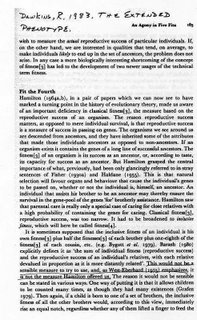
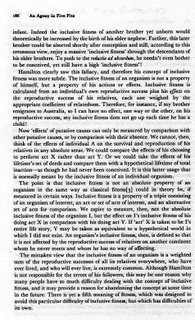
Check it out, it's worth a read: (click to enlarge)
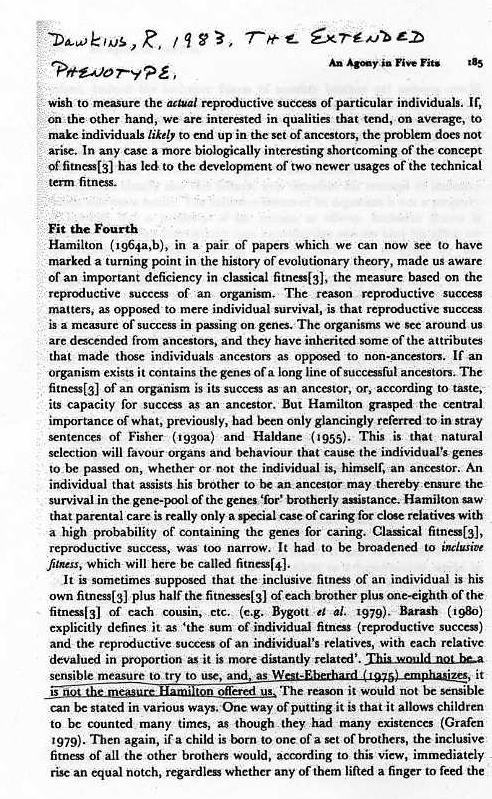
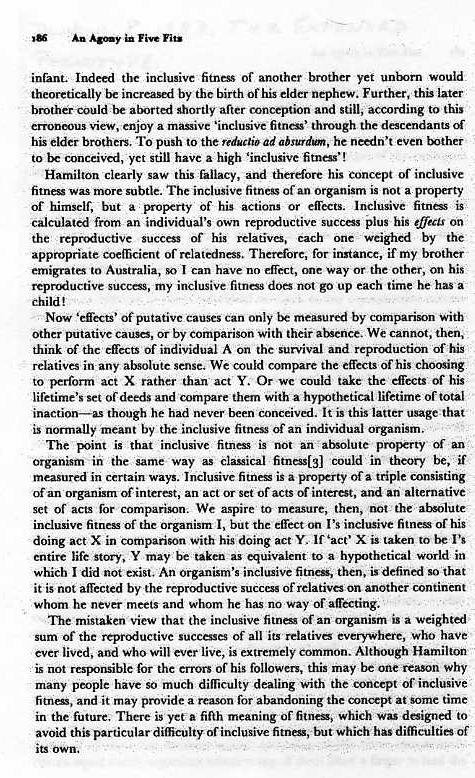
Friday, October 20, 2006
Does God exist. Go.
So I may be a little late to this, but Dawkins was on the Colbert Report the other day. Check it out below.
Wednesday, October 18, 2006
Groovy UV (so cheesy)
Apparently birds that nest in dark places have eggs with UV properties, just as we use UV to spot detergent on Aaron's shirts. ;) See below--pretty amazing that they can do that!
Dark nests and egg colour in birds: a possible functional role of ultraviolet reflectance in egg detectability
Dark nests and egg colour in birds: a possible functional role of ultraviolet reflectance in egg detectability
Abstract:
Owing to the conspicuousness of ultraviolet (UV) colour in dark environments, natural selection might have selected UV egg coloration because it would enhance egg detectability by parents in murky nests. Here, we tested this hypothesis by using comparative and experimental approaches. First, we studied variation in egg coloration of 98 species of European passerines measured using UV–visible reflectance spectrometry (300–700nm) in relation to nesting habits. Analyses based on raw data and controlling for phylogenetic distances both at the species and the family levels revealed that hole-nester species produced eggs with higher UV reflectance than those nesting in open habitats. The experimental approach consisted of the manipulation of UV reflectance of the experimental eggs introduced outside the nest-cup of the hole-nester spotless starling Sturnus unicolor and the study of the retrieval of these eggs. Ultraviolet-reflecting eggs (controls) were more frequently retrieved to the nest-cup than non-reflecting (–UV) eggs. These results were not due to ‘–UV’ eggs being recognized by starlings as parasitic because when a parasitic egg is detected, starlings removed it from the nest-box. Therefore, these results are consistent with the hypothesis that UV egg colours are designed to provide highly detectable targets for parent birds in dark nest environments.
Sunday, October 15, 2006
Interesting NAS conference
Another student here at Utah will be attending an upcoming NAS "Sackler colloquium." I'd never heard of these before, but this one sounds particularly interesting. I thought I'd post the link just in case any of you feel like attending a short conference at the last minute (and there are apparently still travel funds through NAS available!). There are also other interesting evolution related ones--check 'em out, attend one, and then tell me all about it! ;)
Here's the link.
Here's the link.
Thursday, October 12, 2006
MILG--Mother I'd like to Guard
Hey guys,
Did you see this theoretical paper in Proceedings that models when offspring should "mother guard" to protect their inclusive fitness interests? Pretty intriguing! Any thoughts on how/if this might work in humans? See the abstract below.
Mother guarding: how offspring may influence the extra-pair behaviour of their parents
Justin A. Welbergen* and Suhel Quader
In this paper we propose a novel form of social control of mate choice. Through mother guarding, offspring can help in protecting the paternity of their father by preventing their mother from engaging in extra-pair matings. We present a model that predicts the circumstances under which mothers should be selected to seek or avoid extra-pair matings, and existing offspring should be selected to prevent or promote such matings. In its simplest form, our model shows that offspring are selected to mother guard as long as the viability of extra-pair young is less than twice that of within-pair young; when the relative viability is greater, offspring are selected to promote extra-pair mating by their mother. If the existing offspring are not necessarily sired by their mother’s social mate, then the potential for conflict is further reduced. We also consider whether offspring have an interest in the extra-pair reproduction of their fathers. We show that when the costs of the father’s infidelity to the mother’s brood are high, existing offspring are selected to prevent extra-pair mating by their father; when such costs are low, offspring are selected to promote extrapair mating by their father. In principle, our model applies to all species where offspring show delayed dispersal and where breeding pairs raise multiple broods or litters. This situation exists in, but is not limited to, the majority of cooperatively breeding species. The significance of this model with regard to our current understanding of the evolution of extra-pair behaviour in such species is discussed.
Did you see this theoretical paper in Proceedings that models when offspring should "mother guard" to protect their inclusive fitness interests? Pretty intriguing! Any thoughts on how/if this might work in humans? See the abstract below.
Mother guarding: how offspring may influence the extra-pair behaviour of their parents
Justin A. Welbergen* and Suhel Quader
In this paper we propose a novel form of social control of mate choice. Through mother guarding, offspring can help in protecting the paternity of their father by preventing their mother from engaging in extra-pair matings. We present a model that predicts the circumstances under which mothers should be selected to seek or avoid extra-pair matings, and existing offspring should be selected to prevent or promote such matings. In its simplest form, our model shows that offspring are selected to mother guard as long as the viability of extra-pair young is less than twice that of within-pair young; when the relative viability is greater, offspring are selected to promote extra-pair mating by their mother. If the existing offspring are not necessarily sired by their mother’s social mate, then the potential for conflict is further reduced. We also consider whether offspring have an interest in the extra-pair reproduction of their fathers. We show that when the costs of the father’s infidelity to the mother’s brood are high, existing offspring are selected to prevent extra-pair mating by their father; when such costs are low, offspring are selected to promote extrapair mating by their father. In principle, our model applies to all species where offspring show delayed dispersal and where breeding pairs raise multiple broods or litters. This situation exists in, but is not limited to, the majority of cooperatively breeding species. The significance of this model with regard to our current understanding of the evolution of extra-pair behaviour in such species is discussed.
Thursday, October 05, 2006
Great minds think alike????
So we all know about Alastair's love of black culture....
Did you know he's not alone in this???
Apparently Robert Trivers identifies more with black individuals than with white individuals. He used to be a member of the Black Panther party, he owns a home in Jamaica, he prefers all-black bars, and he owns some culture typical clothing (well a hat...but I couldn't describe it if I tried).
Anyway...maybe there's something to this? Perhaps it's true that great minds think alike? Or maybe crazy minds? :-P
Did you know he's not alone in this???
Apparently Robert Trivers identifies more with black individuals than with white individuals. He used to be a member of the Black Panther party, he owns a home in Jamaica, he prefers all-black bars, and he owns some culture typical clothing (well a hat...but I couldn't describe it if I tried).
Anyway...maybe there's something to this? Perhaps it's true that great minds think alike? Or maybe crazy minds? :-P
Tuesday, October 03, 2006
SPSP pre-conference
Also, I don't know if you guys already saw this or not, but this year's SPSP pre-conference looks interesting!
Sunday, October 01, 2006
F mate prefs among the Ache
I'm reading a chapter from Hill and Hurtado's 1996 book on the Ache, and I thought this was an interesting conversation revealing what women prefer in a partner. I whole-heartedly agree with these Ache women! ;) But is this captured in a single measure in the 18 Buss prefs, or do you think it's a combination of a few? Anyway, thought y'all might find it interesting too. (Note the joke telling part! ;)
Kim Hill: Achipura, what kind of man could get many women, what kind did women love, the kind who could easily find a wife?
Achipuragi: He had to be a good hunter.
KH: So if a man was a good hunter he could easily find a wife.
A: No, not just a good hunter. A good hunter could find a wife, but a man needed to be strong.
KH: When you say strong, do you mean a man who could beat up others in a club fight?
A: No, women don't like those men. Women don't like men who love to hit others. I mean a strong man. One who would walk far to hunt, one who would carry heavy loads. I mean a man who would work hard when everyone was tired, or build a hut when it was cold and rainy, a man who would carry his children and get firewood at night. I mean a man who was strong. A man who could endure and would not get tired.
KH: Did women love big men then (i.e., men of large body size)?
A: No, they would love a small man or a large man, but he had to be strong.
KH: What other men would be able to acquire a wife easily?
A: A man who was a "good man."
KH: What does that mean, "a good man"?
A: A good man is one who is handsome (attractive face). One whom women love. One who is nice and smiles and tells jokes. He is a man who is handsome. A "good man" is a man whom women love.
Kim Hill: Achipura, what kind of man could get many women, what kind did women love, the kind who could easily find a wife?
Achipuragi: He had to be a good hunter.
KH: So if a man was a good hunter he could easily find a wife.
A: No, not just a good hunter. A good hunter could find a wife, but a man needed to be strong.
KH: When you say strong, do you mean a man who could beat up others in a club fight?
A: No, women don't like those men. Women don't like men who love to hit others. I mean a strong man. One who would walk far to hunt, one who would carry heavy loads. I mean a man who would work hard when everyone was tired, or build a hut when it was cold and rainy, a man who would carry his children and get firewood at night. I mean a man who was strong. A man who could endure and would not get tired.
KH: Did women love big men then (i.e., men of large body size)?
A: No, they would love a small man or a large man, but he had to be strong.
KH: What other men would be able to acquire a wife easily?
A: A man who was a "good man."
KH: What does that mean, "a good man"?
A: A good man is one who is handsome (attractive face). One whom women love. One who is nice and smiles and tells jokes. He is a man who is handsome. A "good man" is a man whom women love.
Friday, September 29, 2006
You guys are gonna kill me, but...
I can't resist posting another cool abstract, this time from Behavioral Ecology. But wait, it's about an anti-predator adaptation I'd never thought about before! And for all you hunters out there, it'll be something fun to test next time you've got to clean your birds. (I'm totally paying attention to this next time I dove hunt with my family!)
Birds often lose feathers during predation attempts, and this ability has evolved as a means of escape. Because predators are more likely to grab feathers on the rump and the back than on the ventral side of an escaping bird, we predicted that the former feathers would have evolved to be relatively loosely attached as an antipredator strategy in species that frequently die from predation. We estimated the force required to remove feathers from the rump, back, and breast by pulling feathers with a spring balance from a range of European bird species in an attempt to investigate ecological factors associated with ease of feather loss during predation attempts. The force required to loosen a feather from the rump was less than that required to loosen a feather from back, which in turn was less than that required to loosen a feather from the breast. The relative force needed to loosen rump feathers compared with feathers from the back and the breast was smaller for prey species preferred by the most common predator of small passerine birds, the sparrowhawk Accipiter nisus. Likewise, the relative force was also smaller in species with a high frequency of complete tail loss among free-living birds, which we used as an index of the frequency of failed predation attempts. The relative force required to remove feathers from the rump was smaller in species with a high frequency of fear screams, another measure of the relative importance of predation as a cause of death. Feather loss required particularly little force among solitarily breeding bird species that suffer the highest degree of predation. Antipredator defense in terms of force required to remove feathers from the rump was larger in species with a strong antiparasite defense in terms of T-cell-mediated immune response. These findings are consistent with the hypothesis that different defenses are antagonistic and that they are traded off against each other.
Losing the last feather: feather loss as an antipredator adaptation in birds
Anders Pape Møller 1 *, Jan Tøttrup Nielsen 2, and Johannes Erritzøe 3Birds often lose feathers during predation attempts, and this ability has evolved as a means of escape. Because predators are more likely to grab feathers on the rump and the back than on the ventral side of an escaping bird, we predicted that the former feathers would have evolved to be relatively loosely attached as an antipredator strategy in species that frequently die from predation. We estimated the force required to remove feathers from the rump, back, and breast by pulling feathers with a spring balance from a range of European bird species in an attempt to investigate ecological factors associated with ease of feather loss during predation attempts. The force required to loosen a feather from the rump was less than that required to loosen a feather from back, which in turn was less than that required to loosen a feather from the breast. The relative force needed to loosen rump feathers compared with feathers from the back and the breast was smaller for prey species preferred by the most common predator of small passerine birds, the sparrowhawk Accipiter nisus. Likewise, the relative force was also smaller in species with a high frequency of complete tail loss among free-living birds, which we used as an index of the frequency of failed predation attempts. The relative force required to remove feathers from the rump was smaller in species with a high frequency of fear screams, another measure of the relative importance of predation as a cause of death. Feather loss required particularly little force among solitarily breeding bird species that suffer the highest degree of predation. Antipredator defense in terms of force required to remove feathers from the rump was larger in species with a strong antiparasite defense in terms of T-cell-mediated immune response. These findings are consistent with the hypothesis that different defenses are antagonistic and that they are traded off against each other.
Monday, September 25, 2006
Ewes young guys ain't got nothin' to worry about
Hi there, EP peeps,
I just thought I'd post an abstract of a study I found kind of amusing. I subscribe to eTOCs from the journal "applied animal behavior science" (which is generally not that useful, but whatever, I checked it off when I was signing up for a bunch of eTOCs). Anyway, I think it was the "sexual performance" bit in the title that piqued my curiosity. So see below for an abstract I found kind of amusing.
(To any self-conscious rams out there: apparently your "sexual performance"--how was that measured, I wonder? (I'm not curious enough to actually read the paper, however)--doesn't matter, just your age. )
Ewes in oestrus, besides being receptive to rams, develop an active search for them. We performed two experiments to determine if oestrous ewes prefer: (1) high or low sexual-performance rams, and (2) 2-year-old or aged (>8-years-old) rams. In the first experiment, the preference of ewes for rams with high or low sexual performances was compared in 16 tests. In the second experiment, 17 tests were performed comparing ewes'’ preference for aged rams (>8-years-old) or young rams (2-years-old). In each test, two rams were tied at equal distances from the point of entrance of the ewe, with a maximum mobility for each ram of 2 m. The first approach to a ram, the quantity of approaches toward each ram (less than one body length), and the total time that the ewe remained near each ram were registered during 5 min. Oestrous ewes did not display any preference according to sexual performance of rams, but spent significantly more time (P = 0.02), and did it in more tests (P = 0.025), with young than with aged rams. Ewes also tended to approach first (P = 0.07), and more times in more tests (P = 0.06), to young than to aged rams. We conclude that ram's sexual performance seems not to influence oestrous ewes preference, and that ewesÂ’ prefer young (2-years-old) rather than aged rams (>8-years-old).
P. S. By "did it", in there, on first read, I thought, "They're using the euphemism "did it" in a (semi-) academic journal?!?!" (Is that what they mean?)
I just thought I'd post an abstract of a study I found kind of amusing. I subscribe to eTOCs from the journal "applied animal behavior science" (which is generally not that useful, but whatever, I checked it off when I was signing up for a bunch of eTOCs). Anyway, I think it was the "sexual performance" bit in the title that piqued my curiosity. So see below for an abstract I found kind of amusing.
(To any self-conscious rams out there: apparently your "sexual performance"--how was that measured, I wonder? (I'm not curious enough to actually read the paper, however)--doesn't matter, just your age. )
A note on ram preference by oestrous ewes: Influence of rams' age and sexual performance
Ewes in oestrus, besides being receptive to rams, develop an active search for them. We performed two experiments to determine if oestrous ewes prefer: (1) high or low sexual-performance rams, and (2) 2-year-old or aged (>8-years-old) rams. In the first experiment, the preference of ewes for rams with high or low sexual performances was compared in 16 tests. In the second experiment, 17 tests were performed comparing ewes'’ preference for aged rams (>8-years-old) or young rams (2-years-old). In each test, two rams were tied at equal distances from the point of entrance of the ewe, with a maximum mobility for each ram of 2 m. The first approach to a ram, the quantity of approaches toward each ram (less than one body length), and the total time that the ewe remained near each ram were registered during 5 min. Oestrous ewes did not display any preference according to sexual performance of rams, but spent significantly more time (P = 0.02), and did it in more tests (P = 0.025), with young than with aged rams. Ewes also tended to approach first (P = 0.07), and more times in more tests (P = 0.06), to young than to aged rams. We conclude that ram's sexual performance seems not to influence oestrous ewes preference, and that ewesÂ’ prefer young (2-years-old) rather than aged rams (>8-years-old).
P. S. By "did it", in there, on first read, I thought, "They're using the euphemism "did it" in a (semi-) academic journal?!?!" (Is that what they mean?)
Thursday, September 14, 2006
Conceptual Foundations of EP?
Ok for our Evolutionary Social Psych class, David assigned a 6 page paper on what we consider to be the conceptual foundations of evolutionary psychology. It's been interesting to me to see what my fellow lab mates chose...while there was some overlap, we all had some things different. What would you guys pick?
Here was the exact assignment: "I am looking for YOUR take--what you perceive to be the most fundamental conceptual foundations of the field. Perhaps 5 - 8 fundamentals, with a paragraph devoted to each, justifying it as a part of the conceptual foundation. Each foundational pillar must be justified, that is, precisely why do you view it as part of the conceptual foundation?"
I already made my choices (the paper is due tomorrow) so I'll reveal them after everyone else posts theirs (that way...mine aren't prompters...). (Please feel free to skip the paragraph but perhaps a sentence for why important would be good for discussion purposes...)
Have fun!!
Here was the exact assignment: "I am looking for YOUR take--what you perceive to be the most fundamental conceptual foundations of the field. Perhaps 5 - 8 fundamentals, with a paragraph devoted to each, justifying it as a part of the conceptual foundation. Each foundational pillar must be justified, that is, precisely why do you view it as part of the conceptual foundation?"
I already made my choices (the paper is due tomorrow) so I'll reveal them after everyone else posts theirs (that way...mine aren't prompters...). (Please feel free to skip the paragraph but perhaps a sentence for why important would be good for discussion purposes...)
Have fun!!
Wednesday, September 13, 2006
Psychological mechanisms vs. behavior: which would win a boxing match?
Hi buddies,
I just thought I'd post a comment about a disappointing experience I had today in a discussion group. Basically, it was a frustrating (though brief--Elizabeth broke it up before it got too intense) discussion of psychological mechanisms vs. behavioral outcomes, and the value of each as products of evolution. Anyway, I probably should've expected as much, as I'm in anthropology here, but hopefully I can at some point get a few people to slow down and appreciate what is driving this behavior they so prize, and that mismatches between psychological preferences and behavior are not just something to be ignored in favor of pure emphasis on behavior. The mechanisms behind this behavior were selected, too. Anyway, arg, there's no need for comments in response to this, I just needed to vent to a sympathetic audience.
I just thought I'd post a comment about a disappointing experience I had today in a discussion group. Basically, it was a frustrating (though brief--Elizabeth broke it up before it got too intense) discussion of psychological mechanisms vs. behavioral outcomes, and the value of each as products of evolution. Anyway, I probably should've expected as much, as I'm in anthropology here, but hopefully I can at some point get a few people to slow down and appreciate what is driving this behavior they so prize, and that mismatches between psychological preferences and behavior are not just something to be ignored in favor of pure emphasis on behavior. The mechanisms behind this behavior were selected, too. Anyway, arg, there's no need for comments in response to this, I just needed to vent to a sympathetic audience.
Saturday, September 09, 2006
Self-deception
Hey guys,
This is a request asking you to keep your eyes out for any literature directly or indirectly related to self-deception. I'll probably have to wait until I leave FAU to start a self-deception project, but at least this gives me time to get my thoughts together.
I just found this study in Proceedings.
"Overconfidence has long been noted by historians and political scientists as a major cause of war. However, the origins of such overconfidence, and sources of variation, remain poorly understood. Mounting empirical studies now show that mentally healthy people tend to exhibit psychological biases that encourage optimism, collectively known as ‘positive illusions’. Positive illusions are thought to have been adaptive in our evolutionary past because they served to cope with adversity, harden resolve, or bluff opponents. Today, however, positive illusions may contribute to costly conflicts and wars. Testosterone has been proposed as a proximate mediator of positive illusions, given its role in promoting dominance and challenge behaviour, particularly in men. To date, no studies have attempted to link overconfidence, decisions about war, gender, and testosterone. Here we report that, in experimental wargames: (i) people are overconfident about their expectations of success; (ii) those who are more overconfident are more likely to attack; (iii) overconfidence and attacks are more pronounced among males than females; and (iv) testosterone is related to expectations of success, but not within gender, so its influence on overconfidence cannot be distinguished from any other gender specific factor. Overall, these results constitute the first empirical support of recent theoretical work linking overconfidence and war." [Overconfidence in wargames: experimental evidence on expectations, aggression, gender and testosterone]
I'm not particularly interested in overconfidence, but it is a form of self-deception.
Thanks.
This is a request asking you to keep your eyes out for any literature directly or indirectly related to self-deception. I'll probably have to wait until I leave FAU to start a self-deception project, but at least this gives me time to get my thoughts together.
I just found this study in Proceedings.
"Overconfidence has long been noted by historians and political scientists as a major cause of war. However, the origins of such overconfidence, and sources of variation, remain poorly understood. Mounting empirical studies now show that mentally healthy people tend to exhibit psychological biases that encourage optimism, collectively known as ‘positive illusions’. Positive illusions are thought to have been adaptive in our evolutionary past because they served to cope with adversity, harden resolve, or bluff opponents. Today, however, positive illusions may contribute to costly conflicts and wars. Testosterone has been proposed as a proximate mediator of positive illusions, given its role in promoting dominance and challenge behaviour, particularly in men. To date, no studies have attempted to link overconfidence, decisions about war, gender, and testosterone. Here we report that, in experimental wargames: (i) people are overconfident about their expectations of success; (ii) those who are more overconfident are more likely to attack; (iii) overconfidence and attacks are more pronounced among males than females; and (iv) testosterone is related to expectations of success, but not within gender, so its influence on overconfidence cannot be distinguished from any other gender specific factor. Overall, these results constitute the first empirical support of recent theoretical work linking overconfidence and war." [Overconfidence in wargames: experimental evidence on expectations, aggression, gender and testosterone]
I'm not particularly interested in overconfidence, but it is a form of self-deception.
Thanks.
Subscribe to:
Posts (Atom)