Funding To Establish A Max Planck Institute In Palm Beach [County]
Florida
17 Sep 2007
The Max Planck Society has received an offer to establish its first
foreign institute in the US: Florida's Palm Beach County unanimously
proposed the sum of $86.9 million for the next 10 years. In the
coming weeks, it is expected that the State of Florida will
contribute funds to complete the financing, and that specific
negotiations on the establishment of an institute will take place.
The County's decision paved the way for the equally necessary
approval by the State of Florida, which intends to boost the sum
provided by the County to a total of $190 million. This would
facilitate the creation of a Max Planck Institute in the life
sciences on the Jupiter Campus of Florida Atlantic University (FAU),
in the immediate vicinity of the Scripps Research Institute.
"Yesterday's decision is a great compliment for the Max Planck
Society. We are very pleased that the County Commissioners have
demonstrated such great faith in us," said MPS President Gruss after
the vote. With the recent addition of Scripps, and now perhaps also
the Max Planck Society, the State of Florida aims to quickly gain a
place in the premier league of the world's biotechnology hubs. The
state hopes to attract yet further internationally renowned research
institutes and biotech companies to its emerging biotechnology
center. This would allow Florida to expand its basis of wealth and
thus ensure its long-term economic success.
The Scripps Research Institute, internationally renowned in the field
of biomedicine, opened its doors on the Florida Atlantic University
campus just three years ago. The prospect of close cooperation on a
shared campus with Scripps is the primary reason for the Max Planck
Society's interest in Palm Beach County. "Scripps and Max Planck are
a dream team for innovative basic research in biomedicine," says
Gruss. The offer extended to the Max Planck Society is also supported
by the local Florida Atlantic University (FAU). The FAU, the fastest-
growing university in the U.S., will be a key partner in educating
junior researchers and will provide the land for the new
construction.
First Institute on American Soil
"We met with incredible support and enthusiasm for our research in
Florida, not only on the business and political front, but also in
the private sector," says MPS President Peter Gruss. "Florida offers
a particularly dynamic environment for outstanding basic research."
If the State were to now follow the positive vote of the County and
also agree to provide funding for the institute, specific contract
negotiations could get under way and the institute could take up its
work as early as 2008. The institute would eventually have three
departments in which 135 employees from all over the world could
carry out their research. At the same time, the Max Planck Society
wants to offer a visiting scientist program and provide lab space for
internationally renowned researchers to carry out their work.
"The Max Planck Florida institute would give us an independent
foothold in the world's most important country for science," says
Peter Gruss, who views the negotiations in the U.S. as part of a
wider internationalization of the Max Planck Society. "We want to
export the Max Planck success model and step up our international
activities in Europe, the U.S. and Asia." In this context, forms of
cooperation can range from partner institutes all the way to full-
fledged Max Planck Institutes.
Monday, November 12, 2007

Friday, October 19, 2007
James Watson: the Bell Curve Part 2?
I'm not sure if anyone's reading this these days, but I just wanted to throw this out there--any comments on this Nobel Prize winning scientist's latest remarks? Or did the newspaper make 'em up?
Emily
Emily
Sunday, September 23, 2007
Man, I'm slow
Will catch up on here soon (the start of classes was a bit of a train-wreck).
For now, I thought I'd post some EP poetry (apparently British) stolen from the EP listserv:
Epilogue
Older men like young fit girls,
That's the way of this old world,
Pretty girls choose wealthy men,
Tall, with status, scoring ten,
Out of ten as alpha males,
Strong protectors, hard as nails...
You may well differ and protest,
- A generalisation at the best,
May speak of values and of dreams,
Say life is never what it seems,
But there's one thing you can't deny,
Men don't give fruit to other guys.
Andy Morley 14/9/07
You can read the whole thing if you're so inclined, on this page:
http://www.andymorley.com
For now, I thought I'd post some EP poetry (apparently British) stolen from the EP listserv:
Epilogue
Older men like young fit girls,
That's the way of this old world,
Pretty girls choose wealthy men,
Tall, with status, scoring ten,
Out of ten as alpha males,
Strong protectors, hard as nails...
You may well differ and protest,
- A generalisation at the best,
May speak of values and of dreams,
Say life is never what it seems,
But there's one thing you can't deny,
Men don't give fruit to other guys.
Andy Morley 14/9/07
You can read the whole thing if you're so inclined, on this page:
http://www.andymorley.com
Wednesday, August 15, 2007
Follow-up to Dawkins' "Root of all Evil"
The first half of Dawkins follow-up to "Root of all Evil" is available on google video. It's called "Enemies of Reason." I've already watched it, and it's very good. It's not really until the end of this first half that he starts to talk about teleological reasoning and evolutionay explanations, so be patient. I don't want to spoil anymore before you've seen it. So go watch it and then we can discuss.
Here's the link:
http://video.google.com/videoplay?docid=8669488783707640763&hl=en-GB
Here's the link:
http://video.google.com/videoplay?docid=8669488783707640763&hl=en-GB
MyDawkinsSpace?
Did you guys see this (on the HBES listserv)? Anyone signing up?
http://richarddawkins.net/social/
http://richarddawkins.net/social/
Wednesday, August 08, 2007
Creationism Museum pictures
Just in case you've been jonesing to get to KY to visit the huge waste of multiple millions of dollars also known as the Creation Museum, here's a set of Flickr pictures someone took and put online for your viewing pleasure. I haven't examined them recently but when I looked at them a couple months ago, the comments below the pictures were definitely worth reading. Enjoy and try to avoid brain implosion: Creation Museum
A couple gems:
Darwin already explained the damn finches!!
Magical origins of incest
A couple gems:
Darwin already explained the damn finches!!
Magical origins of incest
Tuesday, August 07, 2007
Creation Science Cartoon
Ok so here's something entertaining and yet a little on the scary side...just remember our children are the future and we should not let them become dangerous idiots!
Creation Science Cartoon
Enjoy!
Creation Science Cartoon
Enjoy!
Monday, August 06, 2007
Welcome, part II
Hey guys,
So in a super important email discussion (not really), Aaron, Judy and I decided to open up this old FAU EP blog to the rest of our evolutionary-minded colleagues. Who wouldn't love an(other) outlet to discuss evolutionary ideas and articles, right? Anyway, great to have you new people, and feel free to post any interesting findings you come across, questions, ideas, whatever.
So to kick it all off, has anyone come across any neat-o articles lately? What's the coolest paper you've read recently?
(P.S. Sorry for the very high dork factor in this post. I promise future posts of mine will be much more suave and entertaining. ;)
Emily
So in a super important email discussion (not really), Aaron, Judy and I decided to open up this old FAU EP blog to the rest of our evolutionary-minded colleagues. Who wouldn't love an(other) outlet to discuss evolutionary ideas and articles, right? Anyway, great to have you new people, and feel free to post any interesting findings you come across, questions, ideas, whatever.
So to kick it all off, has anyone come across any neat-o articles lately? What's the coolest paper you've read recently?
(P.S. Sorry for the very high dork factor in this post. I promise future posts of mine will be much more suave and entertaining. ;)
Emily
Saturday, July 14, 2007
School Shootings and EP?
Hi Y'all,
Do you have any thoughts about the school shootings, such as VT (Virginia Tech) from an evolutionary perspective? Not all the shooters were "crazy" but some had histories of being bullied or there was a lack of identity with a group (social identity). In other words, they were loners. I'd appreciate some feedback on this since there is nobody over here who thinks from an evolutionary viewpoint.
Best regards,
Mary Ann
Do you have any thoughts about the school shootings, such as VT (Virginia Tech) from an evolutionary perspective? Not all the shooters were "crazy" but some had histories of being bullied or there was a lack of identity with a group (social identity). In other words, they were loners. I'd appreciate some feedback on this since there is nobody over here who thinks from an evolutionary viewpoint.
Best regards,
Mary Ann
Thursday, February 08, 2007
Female fur seals show active choice
This is a Letter to Nature in this week's Nature (oh that was somewhat redundant!) which demonstrates that even in polygynous species female choice plays an important role. I think this has interesting implications for humans, what does everyone else think?
Here's the link to the article: Fur seal article
Here's the link to the article: Fur seal article
Monday, January 22, 2007
Trivers gets Crafoord Prize in Biosciences
The full story is on edge.org
The Royal Swedish Academy of Sciences has awarded the annual $500,000 Crafoord Prize in Biosciences for 2007 to Robert Trivers, Rutgers University, "for his fundamental analysis of social evolution, conflict and cooperation."
Monday, January 08, 2007
Smelling in stereo
Even if you don't listen to the entire story (which is informative), you should at least watch the video. Kind of creepy to watch a student crawling around a field! Anyway, the two Berkeley researchers found through two experiments, in which participants tracked "essence of chocolate," that humans detect different information from each nostril to form a 3D map of olfactory cues. Check out the story here.
Friday, November 10, 2006
Good genes new name for sexy sons???
Steve Gangestad was here at UT this week and gave about the same talk he gave last year at FAU. He also gave our seminar a new in-press paper at JPSP to read (about women's mate preference shifts across the menstrual cycle). He presented some of the data from that paper in his talk but basically these results show that women prefer men who are confrontative, arrogant, attractive (etc) when fertile and do not prefer men who are faithful, intelligent, kind (etc). Well...I started thinking about this...if women want these men when they are fertile, they are obviously attempting to produce offspring with these men. And these are traits that researchers have termed markers of "good genes". But they are only good genes for male offspring who can short-term mate. So how are is this theory different from sexy sons? I asked Gangestad what he thought and got a round-about answer. Then I asked him, "Well you certainly wouldn't want these traits in your daughters would you?" (particularly arrogance and confrontative personalities) and he said no. So I said "well then it seems like to me if you don't want these traits in daughters, these women are trying to get good STM genes for their male offspring, which seems like sexy sons to me." And he summed it up by saying more research is needed.
So I guess the point of all this is...what do you guys think? I'm certainly not denying the research that shows that women drastically shift their preferences when they are fertile, but I guess what I want to know is, are they choosing then to have male offspring who will be good at STM? And what then about their female offspring? (Or I guess I'm also asking...am I totally crazy and way off-base here? ha ha)
So I guess the point of all this is...what do you guys think? I'm certainly not denying the research that shows that women drastically shift their preferences when they are fertile, but I guess what I want to know is, are they choosing then to have male offspring who will be good at STM? And what then about their female offspring? (Or I guess I'm also asking...am I totally crazy and way off-base here? ha ha)
Saturday, November 04, 2006
Entertainment for Evolutionists
So back when I had time to waste, as an undergrad, my roommates and I loved to play Sims--to play "god" with other people's lives. And now, apparently, we can all be god (or natural selection ;) in a video game, Spore, where you evolve from a single cell organism all the way to an interplanetary traveler. It sounds a little goofy, but kinda cool, because you have to use your "DNA points" (or reproductive success) to "mutate" and adjust your features to fit a particular environment. Anyway, just thought y'all might find it of interest. You can watch an entertaining little demo here, or catch the interview I caught here (click on "intelligent design"). It'll be a merry christmas for all the little evolutionists out there. ;)
Thursday, November 02, 2006
Dawkins Dawkins everywhere!
So he was on the Colbert Report, he's on myspace, he's been on NPR...and now he's been mocked on South Park! I'm sure the episode will turn up on YouTube or you can probably see clips of it on Comedy Central's webpage. Basically, Ms(r) Garrison refuses to teach evolution to his class because he doesn't believe it (he says we are the retarded offspring of five monkeys having butt sex with retarded fish frogs) and so the principal brings in Richard Dawkins to explain evolution. Of course he promotes his atheism, converts Ms. Garrison to atheism and apparently changes the whole world. Go Dawkins Go! :)
Tuesday, October 31, 2006
Ammunition for Evolutionists
Hey guys,
Yes, I'm back. Sorry that I've been delinquent in my blogging duites. I won't let it happen again. And I will read the other blogs you guys have posted while I've been on sabbatical. They look really interesting.
Today, a student in our Comparative Animal Behavior class asked Todd and I if we had seen a film called "Icons of Evolution." The student (who is actually very bright) told us that she just viewed this documentary where scientists were discussing some of the problems with evolution by natural selection. Our first response was that she wasted her time with religious propaganda. She then told us that she's atheist and that the film made no mention of God or religion or even Intelligent Design. And she kept stressing the supposed scientific merit of the documentary. Of course, Todd and I didn't think that this film was a legitimate threat, but we promised the student that we would check it out.
Well, our suspicions were correct. The film, which was first a book by the same title, is the work of a creationist, Jonathan Wells. But this guy isn't you're ordinary creationist. He's got a PhD in biology and he's pretty cleaver because his book/film attacks evoluion from a (supposedly) scientific perspective. Check out some of the questions below. These are questions that Wells encourages people to ask their biology teachers, to stump them.
Q: ORIGIN OF LIFE. Why do textbooks claim that the 1953 Miller-Urey experiment shows how life's building blocks may have formed on the early Earth -- when conditions on the early Earth were probably nothing like those used in the experiment, and the origin of life remains a mystery?
Q: DARWIN'S TREE OF LIFE. Why don't textbooks discuss the "Cambrian explosion," in which all major animal groups appear together in the fossil record fully formed instead of branching from a common ancestor -- thus contradicting the evolutionary tree of life?
Q: HOMOLOGY. Why do textbooks define homology as similarity due to common ancestry, then claim that it is evidence for common ancestry -- a circular argument masquerading as scientific evidence?
Q: VERTEBRATE EMBRYOS. Why do textbooks use drawings of similarities in vertebrate embryos as evidence for their common ancestry -- even though biologists have known for over a century that vertebrate embryos are not most similar in their early stages, and the drawings are faked?
Q: ARCHAEOPTERYX. Why do textbooks portray this fossil as the missing link between dinosaurs and modern birds -- even though modern birds are probably not descended from it, and its supposed ancestors do not appear until millions of years after it?
Q: PEPPERED MOTHS. Why do textbooks use pictures of peppered moths camouflaged on tree trunks as evidence for natural selection -- when biologists have known since the 1980s that the moths don't normally rest on tree trunks, and all the pictures have been staged?
Of course, the three of us can give an answer to many of these questions, but image a high school biology teacher trying to respond to some of these! And as further proof that this tactic of scientifically debating evolutionary theory can be effective comes from the fact the bright student in our class was really interested in our responses to these questions.
So as the title of this blog suggests, I've got ammunition for my fellow evolutionists. This link (http://www.natcenscied.org/icons/), which is sponsored by the National Center for Science Education, provides answers to Wells's questions. Another really great resource Todd found is a review of Wells's book that appeared in Nature (http://chem.tufts.edu/AnswersInScience/Coyne-IconsReview.htm). Read this, if you've got time.
So now you're armed.
Yes, I'm back. Sorry that I've been delinquent in my blogging duites. I won't let it happen again. And I will read the other blogs you guys have posted while I've been on sabbatical. They look really interesting.
Today, a student in our Comparative Animal Behavior class asked Todd and I if we had seen a film called "Icons of Evolution." The student (who is actually very bright) told us that she just viewed this documentary where scientists were discussing some of the problems with evolution by natural selection. Our first response was that she wasted her time with religious propaganda. She then told us that she's atheist and that the film made no mention of God or religion or even Intelligent Design. And she kept stressing the supposed scientific merit of the documentary. Of course, Todd and I didn't think that this film was a legitimate threat, but we promised the student that we would check it out.
Well, our suspicions were correct. The film, which was first a book by the same title, is the work of a creationist, Jonathan Wells. But this guy isn't you're ordinary creationist. He's got a PhD in biology and he's pretty cleaver because his book/film attacks evoluion from a (supposedly) scientific perspective. Check out some of the questions below. These are questions that Wells encourages people to ask their biology teachers, to stump them.
Q: ORIGIN OF LIFE. Why do textbooks claim that the 1953 Miller-Urey experiment shows how life's building blocks may have formed on the early Earth -- when conditions on the early Earth were probably nothing like those used in the experiment, and the origin of life remains a mystery?
Q: DARWIN'S TREE OF LIFE. Why don't textbooks discuss the "Cambrian explosion," in which all major animal groups appear together in the fossil record fully formed instead of branching from a common ancestor -- thus contradicting the evolutionary tree of life?
Q: HOMOLOGY. Why do textbooks define homology as similarity due to common ancestry, then claim that it is evidence for common ancestry -- a circular argument masquerading as scientific evidence?
Q: VERTEBRATE EMBRYOS. Why do textbooks use drawings of similarities in vertebrate embryos as evidence for their common ancestry -- even though biologists have known for over a century that vertebrate embryos are not most similar in their early stages, and the drawings are faked?
Q: ARCHAEOPTERYX. Why do textbooks portray this fossil as the missing link between dinosaurs and modern birds -- even though modern birds are probably not descended from it, and its supposed ancestors do not appear until millions of years after it?
Q: PEPPERED MOTHS. Why do textbooks use pictures of peppered moths camouflaged on tree trunks as evidence for natural selection -- when biologists have known since the 1980s that the moths don't normally rest on tree trunks, and all the pictures have been staged?
Of course, the three of us can give an answer to many of these questions, but image a high school biology teacher trying to respond to some of these! And as further proof that this tactic of scientifically debating evolutionary theory can be effective comes from the fact the bright student in our class was really interested in our responses to these questions.
So as the title of this blog suggests, I've got ammunition for my fellow evolutionists. This link (http://www.natcenscied.org/icons/), which is sponsored by the National Center for Science Education, provides answers to Wells's questions. Another really great resource Todd found is a review of Wells's book that appeared in Nature (http://chem.tufts.edu/AnswersInScience/Coyne-IconsReview.htm). Read this, if you've got time.
So now you're armed.
Monday, October 23, 2006
"I care about what's true, not about what's comforting"--more Dawkins
So, as Aaron would say, 'Dick Dawkins' is really hitting his book press tour hard these days. He was on the NPR program the World today, and this interview is slightly more informative (but notably less amusing) than his one with Stephen Colbert last week.
Check it out here.
Check it out here.
Sunday, October 22, 2006
Dawkins on inclusive fitness
So we discussed the mother guarding paper (posted below) this week at our journal club, and Alan Rogers (a geneticist here) pointed out that the authors did not model inclusive fitness correctly. No one but him caught this, of course, but we'd all fallen for a common misconception about inclusive fitness. He passed around this brief excerpt from the Extended Phenotype where Dawkins addresses this. I thought I'd include it here, so we can all be certain of our definitions of this prettttty pretttty prettty important concept. (imagine that last bit in my best Larry David voice.)
Check it out, it's worth a read: (click to enlarge)
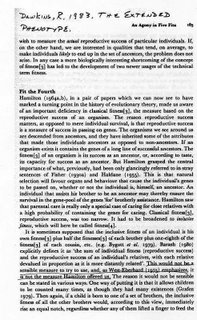
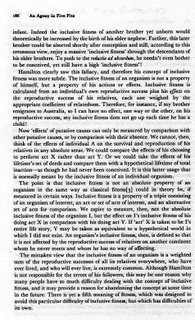
Check it out, it's worth a read: (click to enlarge)
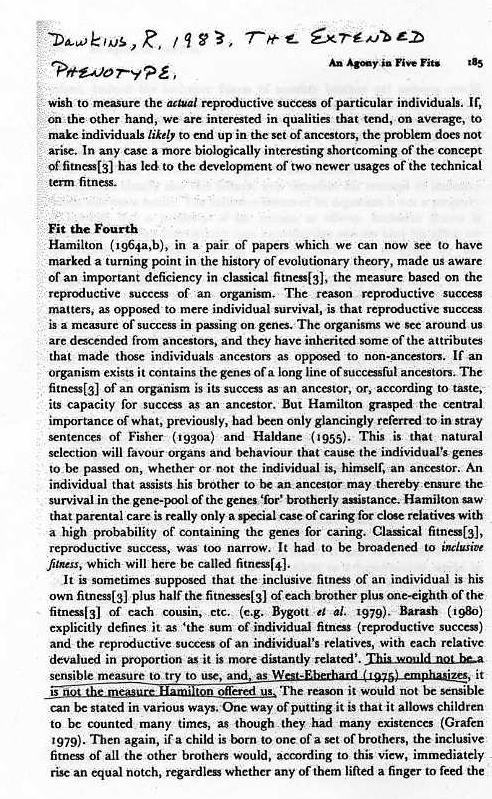
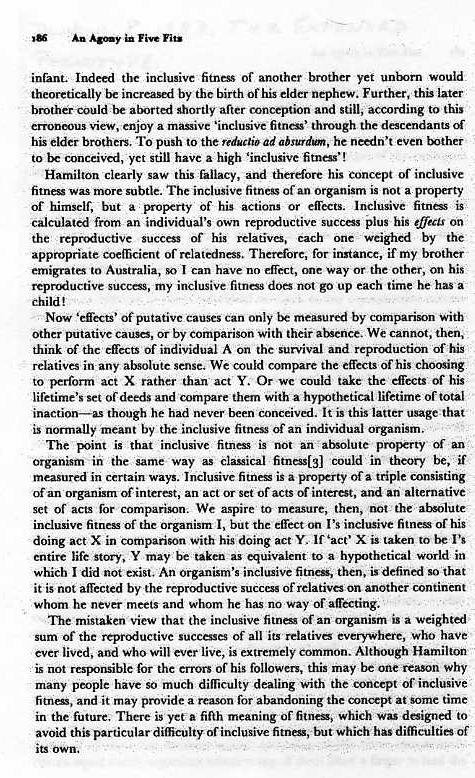
Friday, October 20, 2006
Does God exist. Go.
So I may be a little late to this, but Dawkins was on the Colbert Report the other day. Check it out below.
Wednesday, October 18, 2006
Groovy UV (so cheesy)
Apparently birds that nest in dark places have eggs with UV properties, just as we use UV to spot detergent on Aaron's shirts. ;) See below--pretty amazing that they can do that!
Dark nests and egg colour in birds: a possible functional role of ultraviolet reflectance in egg detectability
Dark nests and egg colour in birds: a possible functional role of ultraviolet reflectance in egg detectability
Abstract:
Owing to the conspicuousness of ultraviolet (UV) colour in dark environments, natural selection might have selected UV egg coloration because it would enhance egg detectability by parents in murky nests. Here, we tested this hypothesis by using comparative and experimental approaches. First, we studied variation in egg coloration of 98 species of European passerines measured using UV–visible reflectance spectrometry (300–700nm) in relation to nesting habits. Analyses based on raw data and controlling for phylogenetic distances both at the species and the family levels revealed that hole-nester species produced eggs with higher UV reflectance than those nesting in open habitats. The experimental approach consisted of the manipulation of UV reflectance of the experimental eggs introduced outside the nest-cup of the hole-nester spotless starling Sturnus unicolor and the study of the retrieval of these eggs. Ultraviolet-reflecting eggs (controls) were more frequently retrieved to the nest-cup than non-reflecting (–UV) eggs. These results were not due to ‘–UV’ eggs being recognized by starlings as parasitic because when a parasitic egg is detected, starlings removed it from the nest-box. Therefore, these results are consistent with the hypothesis that UV egg colours are designed to provide highly detectable targets for parent birds in dark nest environments.
Subscribe to:
Posts (Atom)